Search

running architect.com

sightseeing and other adventures in running shoes

Food and Architects

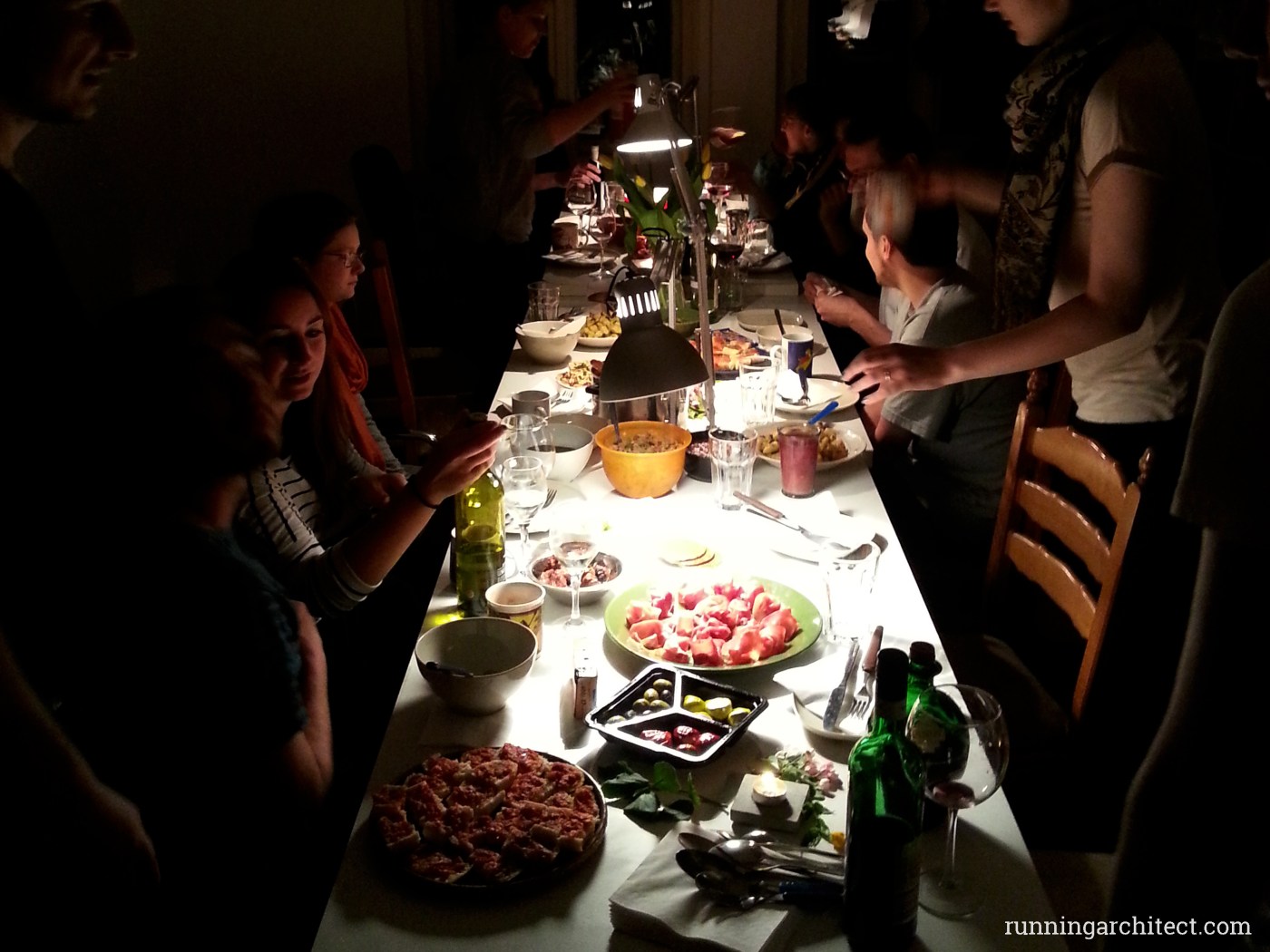
I have been running this page for almost two months now and I think it is time to get to some delicious posts as well. If there is anything I enjoy more than running and architecture, it would be food. First thing to say, I am not vegetarian, neither am I vegan. However, I barely cook meat – I occasionally would prepare chicken but as my friends in Egypt would put it, that does not count into ‘meat’ 🙂 !

I have never been eating much pasta or pizza as child either. I have been in 5th or 6th grade – I guess, when I have tasted the pizza for a first time and I still remember it! You should not feel sorry for me because slovak kitchen is very rich and very unique, plus my mom is the best cook ever (sorry grandma). We used to have plenty of pot-food as my brother calls it, e.g. cabbage pot. Although, I have always been more keen on the sweet dishes. My favourite would be rice soufflĂ© with cherries. Unfortunatelly, any attempts to recreate it on my own have failed so far..

When I started college five years ago, I have been forced to learn how to cook as the food in our cafeteria is not vey delicious. On their behalf, some of my friends would eat there and not say a single bad word about their food, so I guess it is personal. Nevertheless, I could not survive five years on pancakes – even though, I have tried at least for the first semester. So you could say, I have took up cooking out of misery. Yet, I have discovered that it is very popular among architecture students and I have grown fond of it as well very soon. Cooking a dinner with my dearest friends would be my ideal evening. What is more, I have never been on a date in a restaurant – the guys would usually cook for me – three or four courses for a dinner, phew! If you are ladies interested in a man who cooks, just date an architect. They are very foody! They usually read recepies as a sort of input (what is possible) instead of getting instructions, so the flavours are quite unique and your chances of recreating them are rather low. All in all, it never gets boring in architect’s kitchen :).

Evening beauty of socialist housing estate

Despite the fact that I have the luxury of going for a run at any time of a day, I usually end up fighting the dusk. Today, I have returned home in a thick darkness and what is more, it has not been one of the bright starry nights either. Fortunatelly, I have managed to stay out of muddy pitfalls and did not injure myself. I am fully aware, how dangerous are adventures like this one, especially if you run without any light. I am not even going to start on how scared I was, alone in the dark woods. So, I will try avoid any similiar situations in the future for sure.

On the other hand, there was a one nice outcome of the whole irresponsible act of mine. I think, evenings are the most extraordinary time to be walking around town. I am guessing, the most people hate the housing estates built during the socialist era. They are not very appealing in a daylight but they are magical at the dark! You need to take a step back from the block to be able to see the whole canvas. It is very impressive, how those plain facades come to life in various tones – there is everything from blue to yellow or bright white. What is more, the random composition of these lights is constantly changing. It has a certain charm, at least to me.

Winter Hike

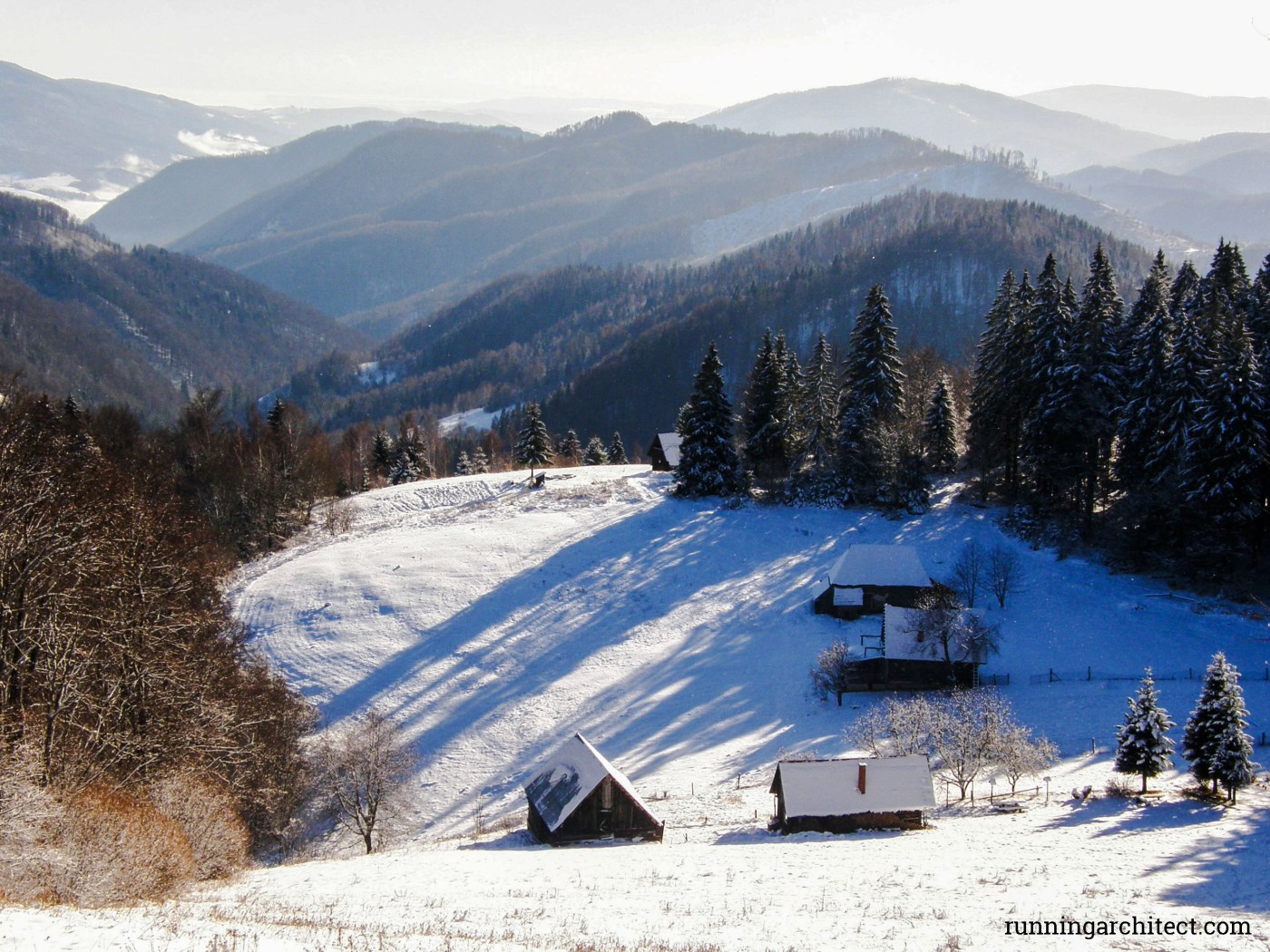
Looking out of the bus window today, it is hard to believe I have been hiking in a winter wonderland last week. Not even the slightest trace of snow on these fields – I just hope, it will be different when I arrive at home. I have travelled this week to Germany as I had some interviews and consultations for my master thesis, so it has been a long week – a lot of socialising as well. Now, I am ready to crawl back into my cave and put my running shoes back on! Till then, I have few more hours in the bus and can at least look at those charming pictures, hoping it will be just the same when I get back.

GALLERY

Only 33.5% of water

It has become a ritual for me to step on the scale each morning. I have been worried about that number for a long time (and I still do). I was quite naive, thinking it is not such a big deal. I saw myself in mirror and I knew, I am not going to work as laundrette model anyway. However, it is not a single number anymore. Since I have got the electronic scale (yes, I used the analog one before!) with few more functions, I use it in a full range of its possibilities now. I will not try to explain how it works but the bottom line is, it can tell you the percentage of fat, muscles and water in your body. I would normally by interested only in the first number. However, the most alarming one is the percentage of water in my body!

I have remembered reading a number about 70% in my biology coursebook! So, I went to do some research and damage control. An article at Wikipedia [Body water] presents an average for women at 48 +/-6%. So, my 33% would still be only 3/4 of the lowest value and despite the fact that I am not a doctor, I can still see how alarmingly low this number is! I have also read that the fat (or they call it adipose) tissue is built only out of 10%, while muscles consist up to 75% of water. So, the more fat you have compared to muscles, the lower number of water would comes out in the end. The fastest way to increase water amount would be dropping the fat percentage and I would, if it were so easy. Believe me, I would be happy to do so right away!

Nevertheless, looking at the poor result, I have evaluated my daily water consumption. I used to drink only about 1-2 Liter water a day back then. So, I have forced myself to drink more. I have been struggling a lot to drink 5 Ă— 0.6 Liter of water to get in at least 3 Lit daily. It would be easier in the summer time, on very hot days I was able to drink up to 5 Lit! However, as soon as the weather cooled down in autumn, I went down to 3 Lit again. I have noticed a slight increase over the past months and I am now constantly at 33,5% – compared to 31 – 32% I used to be last winter. 1.5% is not a victory in any way. However, I can tell when I feel thirsty and when I am being really hungry, which is a great outcome! Furthermore, water has become my new snack and as a result, the fat percentage has dropped. 🙂

All in all, if you are chubby and have an isolating layer of EnEV 2015, there is no way you are doing it right and your whole body suffers. It is not at all about fitting into 36 in your favourite store, neither is it about carrying the extra baggage with you all the time. It it about my health and I have realised how serious the situation has become – even though, I have only few extra kilos.

Master Thesis (5th year)

TASK

adaptive reuse of an acient monument in Italy

LOCATION

Castel Gandolfo, Italy

FOCUS

architectural survey and research, historical reconstruction, design, structural details, preliminary calculations

RESEARCH

Architectural survey on site and evaluation of measured data to determine the remaining substance of the Piscina Torlonia is followed by literature research on the history of the object and its former use and assessing the deterioration of structure. A possible construction process in the ancient time should be examined based on geometry of structure. Furthermore, the original design is visualised.

DESIGN IDEA

..is currently being developed.

GALLERY (the site)

GALLERY (new design)


Melting snowflakes

It has been snowing! It is officially winter time in my calendar. So, I have skipped the long run I had planed for today and went for a walk instead to celebrate this special moment. I felt like twelve-year-old again, catching snowflakes and imprinting my footsteps in various patterns into the fresh white layer. What is more, I will probably have stiff neck tomorrow because I have been constantly looking up. You know, when you look straight forward – the flakes seem to fall so fast but when you look upwards, they are slowly making their way down. It is magical. Everything seems to be in a time loop, slowed down. I especially enjoy when it is about the 0°C and the flakes are huge. And if you try to catch them, they melt on your hot skin immediately – like they were never there. Nevertheless, today I was satisfied even with the smaller versions. There were so many softies, peacefully floating in the air, and from time to time, I have even eaten some of them. They are so delicious – it is almost like eating icecream. Bon appetite!

New address (5th year)

TASK

design various housing units in a small town

LOCATION

Germany, Bad Liebenwerda

ACCENTS

short-term design, housing

IDEA

The new addition to the small town neibourhood is a complex of different typologies targeting three types of tenants – young couples, families, and elderly people. Each group has divers demands, yet they can benefit from sharing the joint space. Proposed layouts of units react on street-yard orientation of structure and so do the openings in the facades -opening up towards the courtyard and staying private when facing the street.

GALLERY

AWARDS

1st prize in the studnet competition awarded by Spaarkasse Finsterwalde (DE)

Folk architecture, Cicmany.

The enchanting village ÄŚiÄŤmany [1] is located in central western part of Slovakia enclosed by mountains StrážovskĂ© vrchy. Originally founded in 1272, the village has been declared a national monument of folk architecture in 1977 (Národná kutĂşrna pamiatka –  rezervácia Äľudovej architektĂşry) due to its unique architecture, traditional clothing and embroidery. There can be found 33 listed objects  – log houses decorated with ornaments in white colour. Through the time, these patterns has developed from simple geometrical drawing into complex art and  have become a part of village´s identity, its trademark and national pride. It took me 25 years to pay this unique place a visit. I have had a good knowledge base going there as I have recently written a paper in school about it [2]. I am not going to bore you with more details. However, my obsession with folk architecture has to be elaborated further. 

I have been frequently asked the question ‘What is there to see in Slovakia?’ and as majority of my friends are foreigners, I have often played a tour guide as well. It is not an easy job to do so here. Slovakia has no pyramids, the number of expectional landmarks is very limited, neither would you find great museums here. Bratislava, the capital of Slovakia, is nothing like those other great historic cities in central Europe, e.g. Prag, Vienna or Budapest. I used to be very intimidated by this fact and have struggled for a long time what to show my friends. You have to know, Slovakia has been a part of Kingdom of Hungary, later a part of The Austria-Hungary Monarchy, and has only recently separated from Czech Republic [3]. Therefore folk traditions and local architecture were the only mean to form a national identity and the high culture has been absent for centuries. Yet, I have learned to look at things from different angle when studying architecture. I have reased, folk music and dance, traditional costumes, and vernacular architecture should be considered the greatest Slovak monument with all its intangible aspects and the best part is, they are being embraced even nowadays. 

Folk architecture is very unique and impulsive – it is never finished and constantly changing.[4] It is alive as long as there are people (folk) who maintain those traditions and it becomes extinct when the last member passes on. Unfortunatelly, folk architecture is lacking external publicity. You can read about renaissance palaces, gothic cathedrals, or english gardens – they all follow some specific set of rules, yet the folk architecture is a mystery. It works with random ideas, sometimes even very strange ones. That is the part I appreciate most about it.

However, ÄŚiÄŤmany, its urbanism and structures themselves, is the only folk monument which was created based on plan. The majority of current urban pattern is based on master plan proposed in 1923 and most log-houses were constructed in 20th century. The reservation of folk architecture includes all in all 115 objects, 32 are listed on as heritage, yet only 3 houses have been built before 1921. Nevertheless, these objects represent a valuable documentation of original type of rural housing objects in the region, traditional building techniques and for the village characteristic decoration elements with unique emotional impressiveness.[5] Furthermore, the village is a rare example of preserving folk architecture under supervision of conservation experts, including architects and urban planners. Chosen approach to reconstruct the village as a whole unit after the destructive fires in 1907 and 1921 prove the historical and cultural significance of the place even at the beginning of 20th century. It is also one of few conservation projects in the central Europe from this period. We might not have Versailles in Slovakia but we definitely have plenty to offer as well – even some unconventional sights. 

The best part about folk architecture is, you do not need a college degree to understand it. It is quite straight forward, made by people for people, pleasing your eyes. You can check out some samples from Cicmany in the gallery attached below. It is like entering a kingdom of gingerbread houses.


GALLERY


[1] Čičmany/Cicamny, Slovakia: N 48.956539,  E 18.516933

[2]  Living monuments vs. conservation – conserving heritage in use, case study Cicmany. If you are interested, please contact me and I will email it to you.

[3] The Slovak Republic was founded 1.1.1993. So it has been only 22 years of independency compared to centuries of being governed by other nations.

[4] There are roots of the term living monument.

[5] Some examples of ornaments could be found on p.8 in a Master Thesis of N. Simova (2013) here.
 

Frozen blueberries

I have been horrified after reading news this morning, yet I do not want to dive here into a political piece. Nevertheless, I have decided to go for a hike today and breathe in the last sunny moments of this autumn. According to weather forecast, tomorrow should begin the rainy version of fall and the magnificent views will be hidden for some time. Since I have moved back home from the flatest part of Germany, I have been trying to avoid altitude and steep hills on my runs. It is not an easy job to carry those extra kilos uphill, I get out of breath very quickly and my HR are rollercoasting. Anyway, the central part of Slovakia is everyhing except flat and so I have been recently struggling a lot. So if the climb is steep, I do not even attempt to run. I hike instead. I pack a full camelbak of water, put camera and dry clothes into backpack and turtle my way up.

I rarely pack some food or snacks, I would have a proper breakfast/or lunch before and then I would leave. So, I usually do not refuse any wild berries I find on my way. There is strawberry time in June, rapsberry season in July/August, blue- and blackberries would ripen in August/September, and the last would be cranberries. It is not a secret that the wild berries have more intense flavour when compared to the store fruit. Should I pick my favourite, I would say I love wild strawberries, they taste much better than the normal once. I am less passionate about rapsberries. They are delicious, yet I am repelled by the high number of worms I have found in them – I rather pass this sort of wildlife. On the other hand, I would definitely not hesitate about blueberries and they are definitely higher on my preference list than cranberries are. Nevertheless, it is middle of November and occasionally snowing in the mountains, so I was very pleased when I found some blueberries on the bush today as well. Some of them were frozen, the others were dried. Still, this did not stop me from eating them. 🙂

It was a very sweaty hike, yet I did enjoy the time outdoors. And who knows, maybe the next time I will go there on my ski – and then the blueberries will have already become a lactose-free blueberry ice cream!


GPX-file

GALLERY


Blog at WordPress.com.

Up ↑