Search

running architect.com

sightseeing and other adventures in running shoes

Sporty Sunday Vol.02 – Saxon Switzerland

Moving to the southern Brandenburg (DE) has at least one great perk – I live closer to Saxon Swizerland [1]. So, I have finally packed a small backpack and went for a hike accompanied by a friend of mine (hence, there are also pictures of me in the gallery 🙂 ). I have already been in the southern part of the mountains before but I think the northern part (everything above the river Elbe) is even more impressive. Mountains never get old for me and to be honest, I haven not seen even half of those charming spots there yet. I am sure, I wil be returning there soon. If you are a fan of climbing on sandstone or you just love rocks, I would definitely recommend putting it on your list. I am sure, you will be able to find some recommendations on the Internet – there are plenty of routes, some are more challenging than others. You can check out our route in the file attached below. The best part is, the most of the paths are completely runnable if you can chatch a breath.. Enjoy.

GPX-file

GALLERY

[1] You can read more about Saxon Swizerland at Wikipedia.

Enjoying the springtime.

I have a little confession to make, I been very lazy lately – if you are in a similiar mood, you might want to check out my favourite song for these days: Couch potato by Shortstraw [link here]. So, I have decided to at least grab a camera today and go for a short walk in the fields. Afterall, I do not want to miss out the most colourful time of year, plus I have bought myself a real camera. I have got lucky and the sun was out so I hope you will get at least an essence of my little adventure today.

GALLERY

Lovely lookout points in Brandenburg

Growing up in the mountains, Nizke Tatry (Slovakia), it has been a hard transition for me to get used to living on plain. If you have ever visited Brandenburg or you happen to live here, you would know, how flat this area is. I was used to climb up a hill and be able to see things from above – to gain a certain distance from the rush in the town. It was always easy to find a piece of quiet up there, even though I have gained that perspective only recently. As they say, you become aware of good things only after you lose them. Nevertheless, I am not the first nor the last person longing for opportunity to stuck my head into the clouds. So it should not come as a surprise, there are plenty of lokout points in Brandenburg. Today, I would like to present my two favourites to you – they oth have been built as a part of IBA 2000-2010. Both objects are very interesting, yet not in the same way. If you fancy interesting architecture, you would love Rostiger Nagel. You can take plenty of nice shots there. However, if you are planing on seing magnificent nature and find some peace, you should visit the one at Felixsee.


1) Tower at Felixsee, Bohrsdorf.  N 51.616487, E 14.547338

If there is a one sport I have fallen in love with living in Germany, it would be swimming in the pond. I have to admit, I used to be quite scared  to swim in open water, I was horryfied I will get tangled in waterplants and drawn. Yet, going to the beach with my friends and swiming in Groups helped me overcome this fear. So, I cannot imagine spending a sunny Saturday anywhere else than somewhere close to water. It is safe to say, there are so many ponds and lakes in Brandenburg (..and also in Mecklenburg-Vorpommen, etc.). Some of them are muddies than others and soem of them larger beach attached etc. If I were to pick one lake I like the best, it would be the Felixsee (1). The water is so clear, and the lake is quite deep so there are barely any plants there. It is a perfect place for a daytrip in summertime – I would bike there but you can definitely get there by a car as well.

The tower itself is a ca. 30m high wooden structure and you can enjoy a nice view from the top – the lake, vast forests, some chimneys from the powerplants close by, and of course you can find some wind-wheels on horizont as well. To get some impressions, check out the gallery attached below.

GALLERY


2) Rostiger Nagel, Senftenberg. N 51.527224, E 14.099115

I have acctually heard about Rostiger Nagel in class. So, we have decided to check it out afterwards, yet it was too far to walk from Senftenberg. Considering the fact, we had no clue in which direction the thing was – it was kind of spare-the-moment-trip-and-jump-on-the-train, we have ended up eating icecream in Senftenberg and returned home. Ever since, it was on my list of things to visit one day. So, last weekend I have finally manage to get there. 🙂

The tower is literally a 30m-tall rusty nail (Rostiger Nagel) placed in the middle of a former strip mine landscape which is currently being flooded. It was built out of corteen steel and has some impressive details as you can see in the gallery below. Waiting four years to see the thing, I was a little bit disappointed by this project. it might be a very impressive object but the landscape around is still transforming and I missed the opportunity to lay down on the beach and swim in the lake.


GALLERY

Sporty Saturday Vol.01 – Running flat and straight forward

I have mentioned in my recent post that I have moved back to Germany, and I happend to live in a small villiage (population of ca. 4.000 people) in Brandenburg. After a half year spent in the beautiful mountains of Slovakia, I am back on plains again. At the beginning, I have been enthusiastic about it as training in altitude for several months contributed to the increase the number of my red blood cells and therefore I found it easier to run down here. When I started running in the mountains (up to 2.000m altitude) in November, I was not able to climb a hill without taking multiple breaks on my way up. So, I have tried, tried and tried. At some point in January, I have noticed the improvement and was quite sad to move back to the flattest area in the Europe. I dare to say, even in Netherlands you would find more hills than here :). However, it has a certain advantages. If you are running flat with the extra strength from hills, it is so much easier. My PRs are stellar comparing to those from back home and I can feel the wind in my hair when running :-). If you are an amateur like I am, you probably know the excitement of discovering speed on your runs.  Unfortunatelly, it can get little boring from time to time. All pictures you take are in landscape mode and there is definitely no need for panorama shots anymore. On the other hand, it is always nice to be a new place – new great trails which need to be explored! So, I have been quite busy these past weeks and I have spent great deal of time on movescount.com planing my next move. I prefer to look at the map, plan ahead and then put my shoes on. It would be irresponsible to run out into woods without having a clue where you are and checking my phone for the curent location every few minutes is annoying. So, I just put the route into my watch and they show you the direction to the next point of interest etc. Very simple, I have grew very fond of this feature lately.

All in all, I have already run some kilometers and can already pick some favourites. I have to say, I used to love to run along the river before, when living in Cottbus. Now, I prefer the woods. I have tried to put in 10k along the river here but I have having hard time finishing them! It was like never ending story. On the other hand, when I run in the forest, the time flies! I have put together a small gallery of impressions, I have collected over past weeks. I have been going for a run mostly in the morning, before work. Yet, there are even some shots taken on the runs after work. Either way, the light was usually very soft :). I hope you will enjoy it!

GALLERY

New Regular Topics coming soon..

I have recently stumpled upon a blog [link here] and I really liked the foodie friday posts. What a great idea. It has got me thinking, I am very casual about writing posts – I am missing regularity and if I ever come up with a story, it is very random. I also find it very difficult to compose an article on a topic I have written about before as I am afraid you might get bored by it. However, people obviously do not get bored by certain topics. My articles on (white and dark) chocholate granola is a living proof [link here and here].They were quite similiar to me but I have got a positive feedback on both – I did not expect that to be honest. Foodie articles get never old :). So, I have got inspired and have decided to take a more systematical approach to writing. I will definitely keep you updated on my current favourites – trails, music, recipes and some work stuff as well.

So stay tuned for more, we will start very soon!

Breaking into real world

You might have noticed I have been working on my master thesis [more on the topic here] and the next logical step would be looking for a job. I am kind of lucky, I could skip that part as I have recieved an offer before I have got to the point of sending out applications – good score, right? Long story short, I have entered a student design competition last June. I have been quite happy with my contribution and so was the jury [more about the project here] and then, at the award reception, I have met my future boss. He was looking for an young architect fresh out of school to work on housing projects of similiar volumes. He runs a familly business, among others also a construction company located in Brandenburg [1]. I have been intrigued by this offer and have took a meeting with him. The point is, I have started my first real job on the 1st February and moved to a very small town (ca. 4.000 inhabitants) in eastern Germany. I have been working before – tutoring since my second year and I have had some other jobs in research as well. Hence, I have never had to leave the university bubble until now. I have spent last five years in Germany, yet I was not acctually living there. It has got better when I moved out of dorms but I was still meeting only students. Looking back, I seemed to have very strange priorities and problems. As the most students, I did not  worry about buying matching furniture or having set of nice pots to cook in, anything clean worked just fine. I think this attitude is very reasonable – you have a limited budget, plus you care only about passing the classes and having fun. Yeah, I have been in that bubble for last five years. However, I think it is time to grow up for good, set up a saving account and buy those matching curtains. I will be earning good money, and have plenty of free time – maybe. I think going to work is not as time consuming as studies, you get at leas the weekends off. Therefore, it is an improvement comparing to my scedules when being to school, I have basically spent seven days either in classes or in studio. So, I have not had a free weekend in a long time.. and if I were to add the number of my pyjama lazy days in a year, I will certainly not go over the 25 (which is number of my vacation days in a year, and I did not include the state holidays!). I admit, it gets harder when you have kids but I am not even in a serious relationship yet. So, I will have the absolute freedom for the first time in my life. The strangest thing of all is, I am already looking for that boring life of an adult. After five years of rollercoasting, I was happy to dive into a routine – scedule regular workouts, plan my meals in advance and sleep properly. I was very excited and glad to abandon my college life (and have not regreted it yet).

It has been almost two weeks of work and I hold my head still up. I am constantly learning new things – it is kind of ovewhelming but I am getting the hang of it! I have had the first meeting with building authorities, they are not as scary as I imagined :). Everything is so real, I have had already two site visits – it is a housing project, redesigning an old villa. Very charming view, I would definitely want to move in! You can check out first impressions in the gallery attached below. What is more, I have spent last weekend at the Baumesse [building fair] in Chemnitz. I loved it there, and if you are a student, I would definitely recommend visiting these things – you will see plenty of interesting products there. If you are kind of hands-on-learner, it is a perfect opportunity to get in touch with the construciton world. They have so many samples there, it was very exciting.

Anyway, the working class has to do the dishes now, then some core training and get the eight hours of beauty sleep, so have a nice evening and stay tuned for more updates.


[1] Brandenburg is the flatest area in Germany, the land around Berlin.


GALLERY

Bedrich Schnirch. The first suspended steel roof.

I have been thinking about posting another recipe of a granola but then I have decided to write about more interesting topic this evening. I have noticed that I have not written about anything serious in a long time. Finally, a perfect idea crossed my mind yesterday. A lot of you guys liked the article on the folk architecture in Cicmany [link] and I thought I will do another piece on something very close to my heart. In the course of my studies, every time I attended a class where we were supposed to compose a paper, I have always been asigned to work on a topic with case study in Slovakia. To be honest, it is not an easy task to do especially if you have spent your college time aborad. I would usually have to look very hard to come up with something interesting. I have recently took a class ‘Design in existing context/ Renovation and alteration of architectural heritage’. It was a very interesting subject and I have learnt a lot about the industrial heritage – suspension bridges from the end of 19th century in particular. Anyway, I was supposed to write a short paper concearning a related topic. My problem was, Slovakia used to be quite agricultural land and the industrial revolution arrived very late, so I was short on interesting objects. There were no preserved suspension bridges to write about. However, I have accidentally stumbled upon an engineer Bedrich Schnirch and the rest of the paper came together very easily.

Bedrich Schnirch (in German literature Friedrich Schnirch, 1791-1868) was a czech engineer, inventor, and architect. He is known for designing the first suspended bridge on the european land as well as designign the first suspended bridge for a railway traffic. However, only few sources mention his work on the field of suspended roof constructions, neither do they mention his patent of a chain roof form 1826. Schnirch started designing and building bridges in Czech Republic, it used to be a part of Austria-Hungary back then, just like Slovakia, and later on moved to Vienna. The most of the bridges he had designed have been replaced over the time but there is one last from 1847 in Podolsko. It has been translocated to a new place, Stadlec, in the 1980s but it is still in use.[1] Considering the slow progress of industrial revolution in Slovakia, the time Schnirch has been working on his significant projects, all his structures vere build exclusively out of wrought iron. [2] The first puddling oven in Slovakia has been put into use in 1839. So, in his early projects, Schnirch was definitely using handmade steel parts. In the paper written on 10/1824 he describes several parameters of those emelents, e.g. the thinner the part was, the better strength the material performed in the experiments – comparing the determined overall tensile strenght of the mateial. The article (in German [3]) is looking at a hypothetical construction for a theatre, covered by a chain-roof, presenting a contemporary calculations concearning its load bearing behaviour. It is questionable, wheather was Schnirch fully aware of the Navier´s theoretical work on suspended construtions composed in 1823 [4] when composing this article. It could have been based on his own experience aquiried during planing and construction the bridge in 1823-24 in Staznice, span 29.71m.[5] Nevertheless, Schnirch introduced here the term suspended roof construction and has also registered a patent on the small chain-roofs. He presented this solution as a fire-resistant construction, as it would withstand fire for much longer than just a plain timber skeleton. According to the literature, by the end of 1820s, this solution has been implemented on five/six objects – Straznice, TuĹ™any na Morave, probably two structures in ÄŚeskĂ˝ Brod and two in Banska Bystrica. 

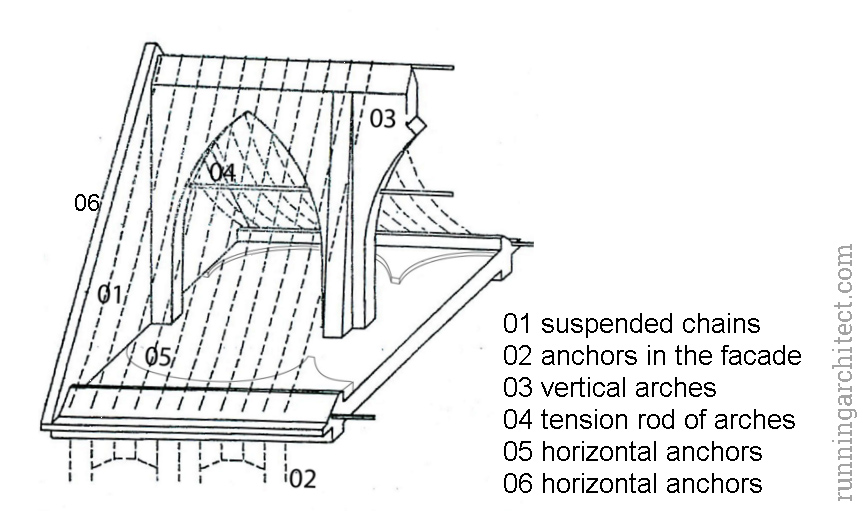
The first prototype has been designed in Banska Bystrica in 1826. There have been found original plans of two buildings in archive in 1960s and afterwards have found one of them still standing. There have been released some short publication back then concearning this great discovery. However, the most publication – except for The Oxford Dictionary of Architecture :), do not recognise Schnirch as an inventor of suspended roof constructions. This one object is acctually still standing there and hundereds of people are walking by every day, not noticing. The house has been originally constructed in 15th-16th century, yet in 1826 it has got a new roof covering area of 12.4 x 25.6m. All in all, 26 chains in the distance of appx. 49.5cm are ankered in the facades and deflected over a two gothic masonry arches in the middle. Each chains is composed of 5 segments made out of crubicle steel with min. 0.8 x 2.5cm (1/3 Zoll x 1 Zoll) [6].

construction

The axonometry shows the load bearing principle and the main construction components. These have been added to the historical substance from 15-16th century in 1826. Vertically, the tensile force from chains is anchered into the facade which is balanced by its dead load. These anchors can be seen in certain areas underneath the plaster. The horizontal share is being distributed into the walls through additional  horizontal arches built upon the ceiling. The diverting is being carried out by two gothic arches built in masonry, these have additional tiebacks from flat-steel-profiles. The ethernit tiles has replaces the original roof coat and during this reconstruction, a wooden substructe has been added as well. The original roof coat has been built out of cast-iron elements – some of them have been found on site and documented (by third party). However, there are no available measurements. Looking at the holes, where the original wires have been attached to the main chains, an appx. 14,6 cm (equals ca. 5,5 Zoll = 14,487cm) interval has been noticed. On those, Schnirch proposed to hang cast-iron elements of 55 □ Zoll in his article and a sketch presented a rectangularly shaped tiles. So we could come to e.g. 10 x 5,5 Zoll (26,4cm x 14,5cm) big tiles which were overlaping by half of the length. For more vivid image, make sure to click through the gallery attached below. I have left out the structural analysis on purpouse as this article is not supposed to be too scientific. However, if you are interested in more details please let me know so in the comment section.

All in all, I have been fascinated by the simplicity of the structure and its good condition. It has passed about 160 years, yet the chains are (except for one split piece) still intact and the roof still suits it purpose. However, I have been disappointed by the ethernit plates and their wooden substructure which declassified the lightness of the suspended roof.


GALLERY

NOTES

[1] Stadlecky most – link, originally built over Vltava in Podolsko, CZ. There is a video of translocation and the process of rebuilding it in Stadlec here. It is unfortunatelly in Czech, sorry. More impressions of the bridge could be find here.

[2] 1740 begins the production of crucible steel, the process has been invented by Benjamin Huntsman. However, the production in similiar ovens has started in Germany in 1823, thanks to Friedrich Krupp and his mild steel. In the mean time, Henry Cort has produced puddled steel in 1784 and England has become a leader in the business for many coming years.

[3] Ueber Dachstühle von Schmiedeißen, deren Leichtigkeit, Wohlheit und Anwendbarkeit, written in October 1824, published in Mittheilungen der k.k. Mährisch-Schlesischen Gesellschaft… 12/1824, 01/1825, incl. drawing.

[4] Calude Louis Marie Henry Navier (1785-1836) has contributed a great deal to Mechanics and Analysis through his life. In 1823, he published Rapport .. etc mĂ©moire sur les ponts suspendus in French. It is a remarkable work regarding suspended bridge constructions and their static and dynamic behaviour, it is also responsible for the boom of suspended bridges in late 1820s. The paper has been partially translated into German in 1825 by J.F.W.Dietlein (1787-1837), Berlin. The full german version has been presented in 1829 by J.G.Kutschera in a paper Bericht an Herrn Becquen und Abhandlung ĂĽber die (Ketten-)HängebrĂĽcken von Herrn Navier. So, the only way Schnirch would based his article on the Navier’s work were if he understood French, which is possible, yet not proved. 

[5] The suspended bridge in Straznice has been erected as the first of its kind on the european land in 1823-24 and served till 1857(61). The first suspended bridge in steel has been builtby James Finley in 1801 in USA and the first in Europe came around 1817 – designed also by Finley.

[6] The contemporary units converted into metric system.

1 Linie – 1/12 Zoll
1 Zoll = 0,02634 m = 2,634 cm
1 □ Zoll = 1 Zoll² = 6,937956 cm²
1 cub. Zoll = 0,0000 1827 457 mÂł
1 Foot = 0, 316081 mm
1 Klftr (Klaffern) = 6 Foot = 1,896486 m
1 □ Klftr = 1 Klftr² = 36 □ Foot = 3,590494 m²
1 Unze = 28,349g
1 Pfd (libra) – österreichische Pfd = 514,37g = 0,51437kg
1 Cnt = 100 Pfd = 51,437kg
1Pfd/ □ Zoll = 0,070755 kg/cm²
1Cnt/□ Zoll = 7,0755 kg/cm²

Homemade Granola 2.0

After finishing the last bite of my chocolate granola, I have to stock up. I have decided to go for a white version this time, something more colourful and lighter. Basically, it is the same as the chocolate version – check out the last post here. However, we will throw in something new.

INGEDIENTS

  • 500g oat flakes
  • 200g dried cranberry
  • 100g coconut rasper
  • 200g white chocolate
  • 100ml water
  • ca. 35ml oil (sunflower)
  • 1package of vanilla sugar
  • cinnamon
  • black pepper
  • salt

One more time in a visual form:

granola recipe white

HOW TO

We will start the same way as last time. First, you want to boil the water and mix in the chopped chocolate and oil. Keep steering, add all spices – cinnamon, black pepper, vanilla sugar, and salt as well. Put the rest of the ingredients into another bowl and mix them together, pour over the prepared sauce. If you think the mass is too dry, try knead it with your hands. It is a weird initial feeling, I agree, but it is very effective and at last fun as well. When you finish playing with the raw granola, spread it on a baking tray and put into oven for 45min at 110-130°C. I have not mentioned it last time but I have split the mass into two halves and baked them seperately to make sure my granola will be crispy at the end. Maybe it would work even all at once, I just do not want to take any chances :-).


For my surprise, the outcome was very different comparing to the last time. Going light on chocolate made the granola more crispy and definitely lighter. What is more, I have been very impressed by how big the cranberries grew in the oven. Yeah, the baking makes such a difference. The granola is much better than some dried fruits mixed into your muesli. I think, I am adicted and I am already looking forward the third version, I might go with something nutty next time!

Yumm.

Homemade Chocolate Granola

I have been in love with the chocolate muesli from Emco [1] for quite some time. I like muesli in general but I like it better when it has a more complex taste and mixing some dried cranberies into oatmeal just doesnt work for me. Unfortunatelly, Emco does not export to Germany, or at least I have not find their products here yet, so I had to import them on my own. You can imagine, travelling home twice a year, you have plenty other stuff you want to put into your suitcase. So after prioritising my list, I would end up with one, sometimes two 750g package(s) for several months. Nevertheless, those dark days are over now! I have recently mastered a recipe for my own homemade chocolate granola.

INGREDIENTS

  • 500g oat flakes
  • 200g sultana (dried grapes)
  • 100g dark chocolate, at least
  • 100g coconut rasper
  • 100g almonds (crunched)
  • 100ml water
  • 50g honey
  • cocoa powder
  • cinnamon
  • black pepper
  • salt

…and if you dont like lists, here comes a picture:

ingredients chocolate granola

HOW TO
It is quite simple. Basically, you need a delicious sauce made of whatever you like. As it is called a chocolate granola, I will go with chocolate flavour, obviously. First you want to boil the water and add the cocoa powder, stir till the clumps dissolve. If you want to go easy on the calories, you can replace chocolate by adding more powder. In the next step, mix in the chopped chocolate. Also, take it off the fire, there is no need to cook it. It will melt eventually – just keep stirring. I admit, I was also sceptical at the begining about this but it works very well – even with 250g chocolate (hold your judgement). The best part, you avoid the danger of burning your chocolate what would be a crime :). As soon as its molten, add the rest of the spices – honey, cinnamon, black pepper and pich of salt. It sounds a bit crazy, especially adding salt. However, it will create a more complex flavour, so go with it. If you have run off the honey, add some brown sugar. Also, I have recently read that black pepper boost up burning fat, so you can be generous with it. [2]

Put the rest of the ingredients – oat flakes, coconut rasper, almontds, suntana, and whatever else you like in your granola, e.g. hazelnuts or cranberies etc., pour over the finished sauce and mix it up all together. Then, scatter the mass on a baking tray lined with backing parchment or alluminium foil. Now, set the oven for 160°C and wait for ca. 45 min. Do not worry about preheating the oven in advance, at least will the the ingredients get a chance to soak in the sauce! When it is finished, just open the oven, leave the tray inside and let it cool off in that dry air. Afterwards, store your the crunchy granola in a glass to prevent the air humidity getting into it before you do.

Have a delicious breakfast!


[1] Emco Mysli na zdravi – link.

[2] The article about black pepper – link.

Create a free website or blog at WordPress.com.

Up ↑